Trump Threatens to "Annihilate" Iran at the UN. Here's What Actually Checks Out.

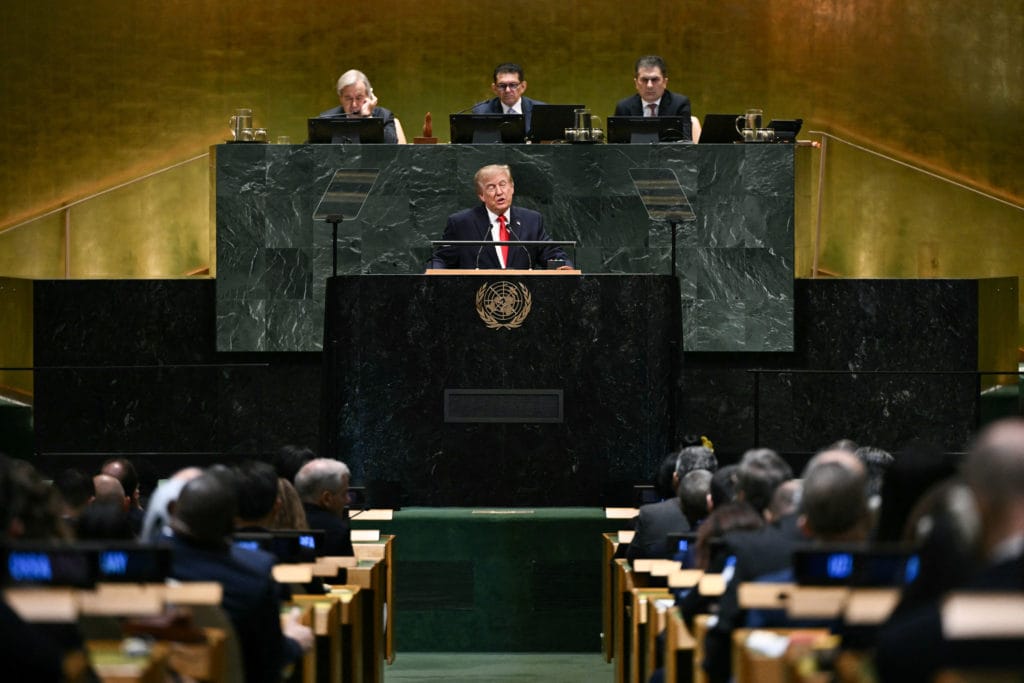
UNITED NATIONS - President Trump stood in front of nearly 130 heads of state at the UN General Assembly Tuesday and said he has two options left on Iran: cut a deal after the midterms, or "annihilate" the Islamic Republic. He called it "settling years of unfinished business," and warned of severe consequences for Iran if talks fail, seven months into a war that PolitiFact notes polling shows Americans are growing weary of. Hours later, he said U.S. envoys had spent three hours with an Iranian delegation and that it "went very well," though his own envoy, Steve Witkoff, said the talks weren't direct. Mediators shuttled messages back and forth instead.
Trump also called Cuba a "failed state" and said the regime "will fall," prompting the Cuban delegation to walk out. He signed a new military agreement with Denmark and Greenland and said the U.S. plans a "large" military presence there. He credited the invasion of Venezuela with securing control of the country's oil. And he said the U.S. "totally rejects any attempt to construct a globalist scheme to control artificial intelligence," floating a plan to rename AI to "superintelligence" in U.S. government documents going forward.
Midterms are less than two months out, and the speech comes after what NPR described as a stretch of legal and political setbacks for the administration. Trump is also about to host Xi Jinping for a summit. Separately, the Wall Street Journal reported that the administration is floating a $5 billion U.S. contribution, matched by Saudi Arabia, the UAE, Qatar and other Gulf states, toward a $10 billion fund to rebuild Middle East energy infrastructure damaged during the Iran war.
What Doesn't Add Up
PolitiFact ran the numbers on several of Trump's specific claims, and most of them don't hold.
He said the U.S. has "more munitions than we could ever possibly even think of using." That's misleading at best. NBC reported in July that the military was rationing munitions and letting some Iranian attacks through because the stockpile is shrinking, not growing. The Center for Strategic and International Studies says systems like Tomahawk missiles and Patriot interceptors will take three to four years to rebuild. The New York Times and Washington Post have reported the same depletion independently.
He claimed the U.S. is "destroying 97% of the drugs coming into the ocean and sea." That's rated false. Seizures have actually dropped since the strikes started, and the administration hasn't shown any causal link between the strikes and less product moving. Seizure counts only measure what gets caught, not what's actually being shipped, and in a black market that second number is unknowable by design.
He said the U.S. and Venezuela together control "more than 60% of the oil in the world." Not close. By proven reserves it's about 21.9%. By current production it's 23.2%. And getting Venezuela's oil sector anywhere near that potential would take years of infrastructure investment nobody's committed to yet.
On AI, he said the U.S. is "leading now over China by a lot," which is only partly true, industry experts put China a few months behind, not far behind, and the gap could close faster if U.S. development slows, which is exactly what AI leaders like Anthropic's Dario Amodei have been asking for. He also dismissed AI-risk concerns as coming from "the same people" behind "the Russia hoax" and climate warnings, though some of the loudest AI-safety voices right now are inside the industry itself: OpenAI's Sam Altman, Google DeepMind's Demis Hassabis, and xAI's Elon Musk all said basically the same thing this year.
The one claim that actually checks out is the Cuba one. Trump's line about Cuba coordinating with groups like the Communist Party USA, Antifa, and the Democratic Socialists of America traces back to a real State Department report from July. The administration has used that report to justify sanctions and an oil embargo on Cuba, sanctions that watchdogs say have made the island's blackouts worse, but the underlying claim about Cuban coordination with U.S. left-wing groups isn't fabricated.
Who's Reporting What
Strip away the tone and most outlets agree on the same core facts: the Iran ultimatum, the Cuban walkout, the Greenland deal, the AI rebrand. Where they split is how much weight to give Trump's version of events.
CNN, NBC, and Bloomberg led with the Iran threat and mostly let it speak for itself. CNBC called the speech "frequently boastful" and framed it around the list of enemies Trump named. ABC7 New York paid attention to the room's reaction more than the content, Trump claimed American supremacy "in literally every category" and got polite applause exactly twice in the entire address. NPR was the most openly skeptical of the timing, tying the speech directly to the midterms and the administration's recent political and legal setbacks. PBS and PolitiFact skipped the horse-race framing entirely and went straight at the claims. Al Jazeera and other international outlets focused less on Trump's words and more on the fallout, the walkout, and the fact that Iran's own president was flying into the same building days after Trump threatened to annihilate his country.
On the claims that can actually be checked, most of them don't survive contact with the numbers.
Sources
- CNN, "Trump says he faces a decision on Iran: make a deal or 'annihilate' the country", Sept. 22, 2026
- NBC News, "Live updates: Trump defends Iran war, discusses Gaza conflict in U.N. General Assembly address", Sept. 22, 2026
- CNBC, "Trump slams Iran and Cuba, defends AI growth in boastful UN speech", Sept. 22, 2026
- ABC7 New York, "President Donald Trump addresses UN General Assembly", Sept. 22, 2026
- NPR, "Trump heads to the U.N. looking for wins after a rough week", Sept. 22, 2026
- PBS NewsHour/PolitiFact, "Fact-checking Trump's speech to the 2026 United Nations General Assembly", Sept. 22, 2026
- Bloomberg, "UN General Assembly Live: Updates From Trump, Leader Speeches in New York", Sept. 22, 2026
- Just Security, "Early Edition", Sept. 22, 2026